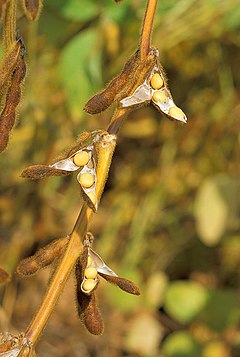
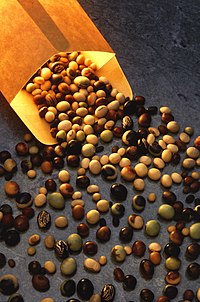
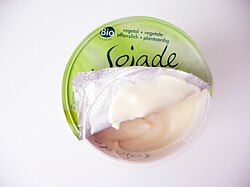
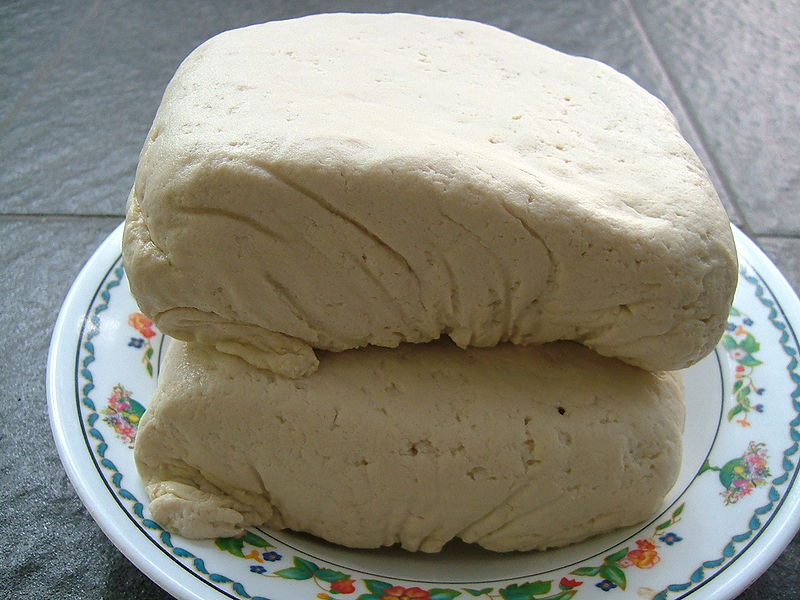
The soybean (U.S.) or soya bean (UK) (Glycine max) is a species of legume native to East Asia. The plant is classed as an oilseed rather than a pulse. Fat-free (defatted) soybean meal is a primary, low-cost, source of protein for animal feeds and most prepackaged meals; soy vegetable oil is another valuable product of processing the soybean crop. For example, soybean products such as textured vegetable protein (TVP) are important ingredients in many meat and dairy analogues.
Traditional nonfermented food uses of soybeans include soymilk, and from the latter tofu and tofu skin. Fermented foods include soy sauce, fermented bean paste, natto, and tempeh, among others. The oil is used in many industrial applications. The main producers of soy are the United States (32%), Brazil (28%), Argentina (21%), China (7%) and India (4%). The beans contain significant amounts of phytic acid, alpha-Linolenic acid, and the isoflavones genistein and daidzein.
Soybeans can produce at least twice as much protein per acre as any other major vegetable or grain crop, 5 to 10 times more protein per acre than land set aside for grazing animals to make milk, and up to 15 times more protein per acre than land set aside for meat production.
The plant is sometimes referred to as greater bean (Chinese dadou and Japanese daizu). In Vietnam, the plant is called dau tuong or dau nanh. Both immature soybean and its dish are called edamame in Japan, but in English, edamame refers only to a specific dish. The English word "soy" is derived from the Japanese pronunciation of shoyu, the Japanese word for soya sauce; "soya" comes from the Dutch adaptation of the same word. Chemical composition of the seed
Together, oil and protein content account for about 60% of dry soybeans by weight; protein at 40% and oil at 20%. The remainder consists of 35% carbohydrate and about 5% ash. Soybean cultivars comprise approximately 8% seed coat or hull, 90% cotyledons and 2% hypocotyl axis or germ.
Most soy protein is a relatively heat-stable storage protein. This heat stability enables soy food products requiring high temperature cooking, such as tofu, soy milk and textured vegetable protein (soy flour) to be made. Since soluble soy carbohydrates are found in the whey and are broken down during fermentation, soy concentrate, soy protein isolates, tofu, soy sauce, and sprouted soy beans are without flatus activity. On the other hand, there may be some beneficial effects to ingesting oligosaccharides such as raffinose and stachyose, namely, encouraging indigenous bifidobacteria in the colon against putrefactive bacteria.
The insoluble carbohydrates in soybeans consist of the complex polysaccharides cellulose, hemicellulose, and pectin. The majority of soybean carbohydrates can be classed as belonging to dietary fiber.
Nutrition
For human consumption, soybeans must be cooked with "wet" heat in order to destroy the trypsin inhibitors (serine protease inhibitors). Raw soybeans, including the immature green form, are toxic to humans, swine, chickens, in fact, all monogastric animals.
 Soybeans are considered by many agencies to be a source of complete protein. A complete protein is one that contains significant amounts of all the essential amino acids that must be provided to the human body because of the body's inability to synthesize them. For this reason, soy is a good source of protein, amongst many others, for vegetarians and vegans or for people who want to reduce the amount of meat they eat. According to the US Food and Drug Administration:
Soy protein products can be good substitutes for animal products because, unlike some other beans, soy offers a 'complete' protein profile. Soy protein products can replace animal-based foods—which also have complete proteins but tend to contain more fat, especially saturated fat—without requiring major adjustments elsewhere in the diet. However, as with many dietary health claims, there are opposing viewpoints on the health benefits of soybeans.
 The gold standard for measuring protein quality, since 1990, is the Protein Digestibility Corrected Amino Acid Score (PDCAAS) and by this criterion soy protein is the nutritional equivalent of meat, eggs, and casein for human growth and health. Soybean protein isolate has a biological value of 74, whole soybeans 96, soybean milk 91, and eggs 97.
Soy protein is essentially identical to that of other legume seeds. Moreover, soybeans can produce at least twice as much protein per acre than any other major vegetable or grain crop, 5 to 10 times more protein per acre than land set aside for grazing animals to make milk, and up to 15 times more protein per acre than land set aside for meat production.
Consumption of soy may also reduce the risk of colon cancer, possibly due to the presence of sphingolipids.
![]() Soybeans were a crucial crop in eastern Asia long before written records. They remain a major crop in China, Japan, and Korea. Prior to fermented products such as Soy sauce, tempeh, natto, and miso, soy was considered sacred for its use in crop rotation as a method of fixing nitrogen. The plants would be plowed under to clear the field for food crops. Soy was first introduced to Europe in the early 18th century and what is now the United States in 1765, where it was first grown for hay. Benjamin Franklin wrote a letter in 1770 mentioning sending soybeans home from England. Soybeans did not become an important crop outside of Asia until about 1910. In America, soy was considered an industrial product only and not used as a food prior to the 1920s. Soy was introduced to Africa from China in the late 19th Century and is now widespread across the continent.
![]() Asia: From about the 1st century AD to the Age of Discovery (15-16th century), soybeans were introduced into several countries such as India, Japan, Indonesia, the Philippines, Vietnam, Thailand, Cambodia, Malaysia, Burma, Taiwan and Nepal. This spread was due to the establishment of sea and land trade routes. The best current evidence on the Japanese Archipelago suggests that soybean cultivation occurred in the early Yayoi period. The earliest Japanese textual reference to the soybean is in the classic Kojiki (Records of Ancient Matters) which was completed in 712 AD.
Many people have claimed that soybeans in Asia were historically only used after a fermentation process, which lowers the high phytoestrogens content found in the raw plant. However, terms similar to "soy milk" have been in use since 82 AD, and there is evidence of tofu consumption that dates to 220.
 Soybeans can be broadly classified as "vegetable" (garden) or field (oil) types. Vegetable types cook more easily, have a mild nutty flavor, better texture, are larger in size, higher in protein, and lower in oil than field types. Tofu and soy milk producers prefer the higher protein cultivars bred from vegetable soybeans originally brought to the United States in the late 1930s. The "garden" cultivars are generally not suitable for mechanical combine harvesting because there is a tendency for the pods to shatter upon reaching maturity.
Among the legumes, the soybean, also classed as an oilseed, is pre-eminent for its high (38–45%) protein content as well as its high (20%) oil content. Soybeans are the second most valuable agricultural export in the United States behind corn. The bulk of the soybean crop is grown for oil production, with the high-protein defatted and "toasted" soy meal used as livestock feed. A smaller percentage of soybeans are used directly for human consumption.
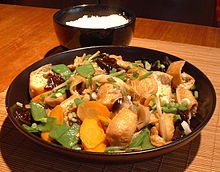
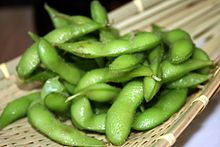
Immature soybeans may be boiled whole in their green pod and served with salt, under the Japanese name edamame,. In English, these soybeans are generally known as "edamame" or "green vegetable soybeans".
![]() In China, Japan, and Korea the bean and products made from the bean are a popular part of the diet. The Chinese invented tofu, and also made use of several varieties of soybean paste as seasonings. Japanese foods made from soya include miso, natto, kinako and edamame. In Korean cuisine, soybean sprouts, called kongnamul, are also used in a variety of dishes, and are also the base ingredient in doenjang, cheonggukjang and ganjang.
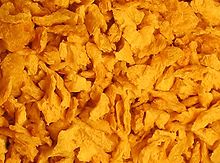
The beans can be processed in a variety of ways. Common forms of soy (or soya) include soy meal, soy flour, soy milk, tofu, textured vegetable protein (TVP, which is made into a wide variety of vegetarian foods, some of them intended to imitate meat), tempeh, soy lecithin and soybean oil. Soybeans are also the primary ingredient involved in the production of soy sauce (or shoyu).
![]() Oil: Soybean seed contains about 19% oil. To extract soybean oil from seed, the soybeans are cracked, adjusted for moisture content, rolled into flakes and solvent-extracted with commercial hexane. The oil is then refined, blended for different applications, and sometimes hydrogenated. Soybean oils, both liquid and partially hydrogenated, are exported abroad, sold as "vegetable oil" or end up in a wide variety of processed foods. The remaining soybean meal is used mainly as animal feed.
Meal: Soybean meal is the material remaining after solvent extraction of oil from soybean flakes, with a 50% soy protein content. The meal is 'toasted' (a misnomer because the heat treatment is with moist steam) and ground in a hammer mill. Soybean meal is an essential element of the American production method of growing farm animals such as poultry and swine on an industrial scale that began in the 1930s; and more recently the aquaculture of catfish. Ninety-eight percent of the U.S. soybean crop is used for livestock feed. Soybean meal is also used in lower end dog foods.
 Flour: Soy flour refers to defatted soybeans ground finely enough to pass through a 100-mesh or smaller screen where special care was taken during desolventizing (not toasted) in order to minimize denaturation of the protein to retain a high Protein Dispersibility Index (PDI), for uses such as extruder cooking of textured vegetable protein. It is the starting material for production of soy concentrate and soy protein isolate.
Soy Products
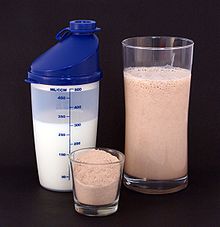
 Soybeans can be processed to produce a texture and appearance similar to many other foods. For example, soybeans are the primary ingredient in many dairy product substitutes (e.g., soy milk, margarine, soy ice cream, soy yogurt, soy cheese, and soy cream cheese) and meat substitutes (e.g. veggie burgers). These substitutes are readily available in most supermarkets. Soy milk does not naturally contain significant amounts of digestible calcium. Many manufacturers of soy milk sell calcium-enriched products as well. Soy is also used in tempeh: the beans (sometimes mixed with grain) are fermented into a solid cake.
Soy products also are used as a low cost substitute in meat and poultry products. Food service, retail and institutional (primarily school lunch and correctional) facilities regularly use such "extended" products. Extension may result in diminished flavor, but fat and cholesterol are reduced. Vitamin and mineral fortification can be used to make soy products nutritionally equivalent to animal protein; the protein quality is already roughly equivalent. The soy-based meat substitute textured vegetable protein has been used for more than 50 years as a way of inexpensively extending ground beef without reducing its nutritional value.
![]() Soybeans are the bean used in Chinese fermented black beans, douchi, not the sometimes confused black turtle beans. Soybeans are also used in industrial products including oils, soap, cosmetics, resins, plastics, inks, crayons, solvents, and clothing. Soybean oil is the primary source of biodiesel in the United States, accounting for 80% of domestic biodiesel production. Soybeans have also been used since 2001 as fermenting stock in the manufacture of a brand of vodka.
 Omega-3 fatty acids, for example, alpha-linolenic acid C18-3, all cis, 9,12,15 octadecatrienoic acid (where the omega-3 refers to carbon number 3 counting from the hydrocarbon tail whereas C-15 refers to carbon number 15 counting from the carboxyl acid head) are special fat components that benefit many body functions. However, the effects which are beneficial to health are associated mainly with the longer-chain, more unsaturated fatty acids eicosapentaenoic acid (20:5n-3, EPA) and docosahexaenoic acid (22:6n-3, DHA) found in fish oil and oily fish. For instance, EPA and DHA, inhibit blood clotting, while there is no evidence that alpha-linolenic acid (18:3n−3, aLNA) can do this. Soybean oil is one of the few common vegetable oils that contain a significant amount of aLNA (others include canola, walnut, hemp, and flax). However, soybean oil does not contain EPA or DHA. Soybean oil does contain significantly greater amount of omega-6 fatty acids in the oil: 100 g of soybean oil contains 7 g of omega-3 fatty acids to 51 g of omega-6: a ratio of 1:7. Flaxseed, in comparison, has an omega-3:omega-6 ratio of 3:1.
![]() Isoflavones: Soybeans also contain the isoflavones genistein and daidzein, types of phytoestrogen, that are considered by some dietitians and physicians to be useful in the prevention of cancer and by others to be carcinogenic and endocrine disruptive. Soy's content of isoflavones are as much as 3 mg/g dry weight. Isoflavones are polyphenol compounds, produced primarily by beans and other legumes, including peanuts and chickpeas. Isoflavones are closely related to the antioxidant flavonoids found in other plants, vegetables and flowers. Isoflavones such as genistein and daidzein are found in only some plant families, because most plants do not have an enzyme, chalcone isomerase which converts a flavone precursor into an isoflavone.
In contradiction to well known benefits of isoflavones, genistein acts as an oxidant (stimulating nitrate synthesis), and blocks formation of new blood vessels (antiangiogenic effect). Some studies show that genistein acts as inhibitor of substances that regulate cell division and cell survival (growth factors).
A review of the available studies by the United States Health and Human Services Agency for Healthcare Research and Quality (AHRQ) found little evidence of substantial health improvements and no adverse effects, but also noted that there was no long-term safety data on estrogenic effects from soy consumption.
Cholesterol reduction
 The dramatic increase in soyfood sales is largely credited to the Food and Drug Administration's (FDA) approval of soy as an official cholesterol-lowering food, along with other heart and health benefits. A 2001 literature review argued that these health benefits were poorly supported by the available evidence, and noted that disturbing data on soy's effect on the cognitive function of the elderly existed. In 2008, an epidemiological study of 719 Indonesian elderly found that tofu intake was associated with worse memory, but tempeh (a fermented soy product) intake was associated with better memory. This study replicated other studies.
In 1995, the New England Journal of Medicine (Vol. 333, No. 5) published-Title- "Meta-analysis of the effects of soy protein intake on serum lipids", financed by DuPont Protein Technologies International (PTI), which produces and markets soy through The Solae Company. The meta-analysis concluded that soy protein is correlated with significant decreases in serum cholesterol, LDL (bad cholesterol) and triglycerides. However, HDL(good cholesterol) did not increase by a significant amount. Soy phytoestrogens (isoflavones: genistein and daidzein) adsorbed onto the soy protein were suggested as the agent reducing serum cholesterol levels. On the basis of this research PTI filed a petition with FDA in 1998 for a health claim that soy protein may reduce cholesterol and the risk of heart disease.
 The FDA granted the following health claim for soy: "25 grams of soy protein a day, as part of a diet low in saturated fat and cholesterol, may reduce the risk of heart disease." One serving, (1 cup or 240 mL) of soy milk, for instance, contains 6 or 7 grams of soy protein. Solae resubmitted their original petition, asking for a more vague health claim, after their original was challenged and highly criticized. Solae also submitted a petition for a health claim that soy can help prevent cancer. They quickly withdrew the petition for lack of evidence and after more than 1,000 letters of protest were received. On February 18, 2008 Weston A. Price Foundation submitted a petition for removal of this health claim.
An American Heart Association review of a decade long study of soy protein benefits casts doubt on the FDA allowed "Heart Healthy" claim for soy protein and does not recommend isoflavone supplementation. The review panel also found that soy isoflavones have not been shown to reduce post menopause "hot flashes" in women and the efficacy and safety of isoflavones to help prevent cancers of the breast, uterus or prostate is in question.
![]() Phytic acid: Soybeans contain a high level of phytic acid, which has many effects including acting as an antioxidant and a chelating agent. The beneficial claims for phytic acid include reducing cancer, minimizing diabetes, and reducing inflammation. However, phytic acid is also criticized for reducing vital minerals due to its chelating effect, especially for diets already low in minerals.
Phytoestrogen
Soybeans contain isoflavones called genistein and daidzein, which are one source of phytoestrogens in the human diet. Because most naturally occurring estrogenic substances show weak activity, normal consumption of foods that contain these phytoestrogens should not provide sufficient amounts to elicit a physiological response in humans.
![]() Plant lignans associated with high fiber foods such as cereal brans and beans are the principal precursor to mammalian lignans which have an ability to bind to human estrogen sites. Soybeans are a significant source of mammalian lignan precursor secoisolariciresinol containing 13–273 µg/100 g dry weight. Another phytoestrogen in the human diet with estrogen activity is coumestans, which are found in beans, split-peas, with the best sources being alfalfa, clover, and soybean sprouts. Coumestrol, an isoflavone coumarin derivative is the only coumestan in foods.
Soybeans and processed soy foods are among the richest foods in total phytoestrogens (wet basis per 100g), which are present primarily in the form of the isoflavones daidzein and genistein.
Women: A 2001 literature review suggested that women with current or past breast cancer should be aware of the risks of potential tumor growth when taking soy products, based on the effect of phytoestrogens to promote breast cancer cell growth in animals. A 2006 commentary reviewed the relationship with soy and breast cancer. They stated that soy may prevent breast cancer, but cautioned that the impact of isoflavones on breast tissue needs to be evaluated at the cellular level in women at high risk for breast cancer. A high consumption of omega-6 polyunsaturated fatty acids, which are found in most types of vegetable oil including soybean oil, may increase the likelihood that postmenopausal women will develop breast cancer. Another analysis suggests an inverse association between total polyunsaturated fatty acids and breast cancer risk.
 Men: Because of the phytoestrogen content, some studies have suggested that soybean ingestion may influence testosterone levels in men. However, a 2010 meta analysis of 15 placebo controlled studies showed that neither soy foods nor isoflavone supplements alter measures of bioavailable testosterone concentrations in men. It has been hypothesized that soy foods and enterolactone may protect against the development of prostate cancer although no significant associations were observed for the soy isoflavones. Furthermore, soy consumption has been shown to have no effect on the levels and quality of sperm.
![]() There is evidence that estrogen can help protect and repair the brain after injury, and it has been suggested that the phytoestrogens in soy may have a similar effect though this is controversial and there is also evidence that phytoestrogens may be harmful for the recovery of rats that have sustained brain injury. A study of Japanese men between 1965 and 1999 demonstrated a positive correlation between brain atrophy and consumption of tofu. A study on elderly Indonesian men and women found that tempeh consumption was independently related to better memory.
Carcinogenicity
![]() Though raw soy flour is known to cause pancreatic cancer in rats the cooked flour has not been found carcinogenic. Whether soy might promote pancreatic cancer in humans is unknown because studies have not yet attempted to single out soy intake and the incidence of pancreatic cancer in humans, and the amount of soy fed to the rats is proportionately far larger than what humans would normally consume. However, the soy isoflavone genistein has been suggested as a chemopreventive agent against pancreatic cancer, by interfering with the chemical pathways that promote the creation and growth of tumors.
The Cancer Council of New South Wales, Australia has released a statement saying scientific research suggests that overall the moderate consumption of soy products does not appear to present a risk to women with breast cancer, and there is equivocal evidence that consuming large amounts of soy products may have a protective effect against developing breast and prostate cancer. However, the Council does not recommend taking soy dietary supplements as there is no evidence they are either effective or safe at preventing or treating cancers.
Reference : http://en.wikipedia.org/wiki/Soybean

A serious attempt at stopping need not involve using nicotine replacement therapy (NRT) or other drugs or getting professional support.

 Step 1: Decide why you want to quit smoking and write those reasons down – all of them. If you get stuck, think about headings like Health, Looks, Finances, Family, Things I’ll be able to do. Now copy these reasons onto another piece of paper headed ‘What Will Happen When I’ve Stopped Smoking’, but change the wording of any negative statements into something positive. For example, if you’ve written ‘I won’t have to spend money on cigarettes’, change that to ‘I will have extra money to spend on anything I like’. Or, if one of your reasons is ‘I won’t cough every morning’, change that to ‘My lungs will feel healthier and less congested’. It may sound strange, but, psychologically, positive thinking is usually much more effective than negative. Every morning, read that piece of paper and focus on each of the statements.
 "Cold turkey" is abrupt cessation of all nicotine use. It is the quitting method used by 80% to 90% of long-term successful quitters in some populations. It’s a good approach, but it’s also the most intense because you will probably suffer strong nicotine withdrawal for 24-48 hours and milder symptoms for a week to ten days. Using the diet detailed over the page will help reduce these, which will make things easier. You should start the diet the day before you decide to stop, then stick to it for at least a fortnight. Also use the controlling cravings tips to help you tackle any urges to smoke that you may develop and keep this up for the next five weeks.
 Gradual reduction involves slowly reducing one's daily intake of nicotine. This can be done in two ways: by repeated changes to cigarettes with lower levels of nicotine, or by gradually reducing the number of cigarettes smoked each day. As of 2010, and unlike earlier studies who claimed some benefit for gradual reduction, a Cochrane review found that abrupt cessation and gradual reduction with pre-quit NRT produced similar quit rates.


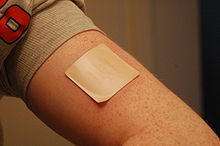
 2) gum
Aromatherapy based treatments and herbal preparations such as Kava and Chamomile, the efficacy of which has not been established.