Showing posts with label Grapefruit-Kiwifruit-Orange. Show all posts

Wednesday, November 17, 2010

Healthy Fruit: Orange

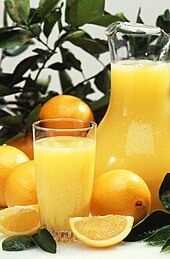
An orange—specifically, the sweet orange—is the citrus Citrus × sinensis (syn. Citrus aurantium L. var. dulcis L., or Citrus aurantium Risso) and its fruit. The orange is a hybrid of ancient cultivated origin, possibly between pomelo (Citrus maxima) and mandarin (Citrus reticulata). It is a small flowering tree growing to about 10 m tall with evergreen leaves, which are arranged alternately, of ovate shape with crenulate margins and 4–10 cm long. The orange fruit is a hesperidium, a type of berry.
Oranges originated in Southeast Asia. The fruit of Citrus sinensis is called sweet orange to distinguish it from Citrus aurantium, the bitter orange. The name is thought to ultimately derive from the Sanskrit for the orange tree, with its final form developing after passing through numerous intermediate languages. In a number of languages, it is known as a "Chinese apple" (e.g. Dutch Sinaasappel, "China's apple").
All citrus trees are of the single genus, Citrus, and remain largely interbreedable; that is, there is only one "superspecies" which includes grapefruits, lemons, limes, and oranges. Nevertheless, names have been given to the various members of the genus, oranges often being referred to as Citrus sinensis and Citrus aurantium. Fruits of all members of the genus Citrus are considered berries because they have many seeds, are fleshy, soft, and derive from a single ovary. An orange seed is called a pip. The white thread-like material attached to the inside of the peel is called pith.
Varieties
Blood orange
Blood oranges are a natural variety of C. sinensis derived from abnormal pigmentation of the fruit, that gives its pulp a streaking red colour. The juice produced from such oranges is often dark burgundy, hence reminiscent of blood. Original blood oranges were first discovered and cultivated in the 15th century in Sicily, however since then their cultivation became worldwide, and most blood oranges today are hybrids.
The fruit has found a niche as an interesting ingredient variation on traditional Seville marmalade, with its striking red streaks and distinct flavour. The scarlet navel is a variety with the same dual-fruit mutation as the navel orange.
Navel orange
According to Dorsett, Shamel, and Popenoe (1917) of the U.S. Department of Agriculture who conducted a study at first hand, a single mutation in 1810 to 1820 in a Selecta orange tree planted at a monastery near Bahia in Brazil, probably yielded the navel orange, also known as the Washington, Riverside, or Bahia navel. However, a researcher at the University of California, Riverside, believes that the parent variety was more likely the Portuguese navel (Umbigo) orange described by Risso and Poiteau (1818-22). The mutation causes the orange to develop a second orange at the base of the original fruit, opposite the stem, as a conjoined twin in a set of smaller segments embedded within the peel of the larger orange. From the outside, it looks similar to the human navel, hence its name.
Because the mutation left the fruit seedless, and therefore sterile, the only means available to cultivate more of this new variety is to graft cuttings onto other varieties of citrus tree. It was introduced into Australia in 1824 and Florida in 1835. Twelve such cuttings of the original tree were transplanted to Riverside, California in 1870, which eventually led to worldwide popularity. The California Citrus State Historic Park preserves this history in Riverside, California, as does the Orcutt Ranch Horticulture Center in Los Angeles County, California.
Today, navel oranges continue to be produced via cutting and grafting. This does not allow for the usual selective breeding methodologies, and so not only do the navel oranges of today have exactly the same genetic makeup as the original tree, and are therefore clones, all navel oranges can be considered to be the fruit of that single nearly two hundred year-old tree. This is similar to the common yellow seedless banana, the Cavendish. On rare occasions, however, further mutations can lead to new varieties
Persian orange
The Persian orange, grown widely in southern Europe after its introduction to Italy in the 11th century, was bitter. Sweet oranges brought to Europe in the 15th century from India by Portuguese traders quickly displaced the bitter, and are now the most common variety of orange cultivated. The sweet orange will grow to different sizes and colours according to local conditions, most commonly with ten carpels, or segments, inside.
Some South East Indo-European tongues name the orange after Portugal, which was formerly the main source of imports of sweet oranges. Examples are Bulgarian portokal, Greek portokali, Persian porteqal, Albanian "portokall", Macedonian portokal, and Romanian portocala. Also in South Italian dialects (Neapolitan), orange is named portogallo or purtualle, literally "the Portuguese one". Related names can also be found in other languages: Turkish Portakal, Arabic al-burtuqal, Amharic birtukan, and Georgian phortokhali.
Portuguese, Spanish, Arab, and Dutch sailors planted citrus trees along trade routes to prevent scurvy. On his second voyage in 1493, Christopher Columbus brought the seeds of oranges, lemons and citrons to Haiti and the Caribbean. They were introduced in Florida (along with lemons) in 1513 by Spanish explorer Juan Ponce de Leon, and were introduced to Hawaii in 1792.
Valencia orange
The Valencia or Murcia orange is one of the sweet oranges used for juice extraction. It is a late-season fruit, and therefore a popular variety when the navel oranges are out of season. For this reason, the orange was chosen to be the official mascot of the 1982 FIFA World Cup, which was held in Spain. The mascot was called "Naranjito" ("little orange"), and wore the colours of the Spanish football team uniform.
Acidity
Like all citrus fruits, the orange is acidic, with a pH level of around 2.5-3; depending on the age, size and variety of the fruit. Although this is not, on average, as strong as the lemon, it is still quite acidic on the pH scale – as acidic as household vinegar.
Orange, raw, Florida : Nutritional value per 100 g (3.5 oz)
Energy 192 kJ (46 kcal) | Carbohydrates 11.54 g
Sugars 9.14 g | Dietary fiber 2.4 g
Fat 0.21 g | Protein 0.70 g
Thiamine (Vit. B1) 0.100 mg (8%)
Riboflavin (Vit. B2) 0.040 mg (3%)
Niacin (Vit. B3) 0.400 mg (3%)
Pantothenic acid (B5) 0.250 mg (5%)
Vitamin B6 0.051 mg (4%) | Folate (Vit. B9) 17 μg (4%)
Vitamin C 45 mg (75%)
Calcium 43 mg (4%) | Iron 0.09 mg (1%)
Magnesium 10 mg (3%) | Phosphorus 12 mg (2%)
Potassium 169 mg (4%) | Zinc 0.08 mg (1%)
Percentages are relative to US recommendations for adults.
Source: USDA Nutrient database


Source, Images: http://en.wikipedia.org/wiki/Orange_(fruit)

Monday, November 15, 2010

Healthy Fruit: Kiwifruit

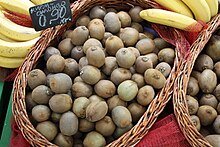
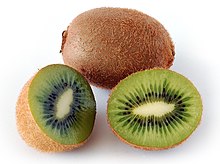
The kiwifruit, often shortened to kiwi in many parts of the world, is the edible berry of a cultivar group of the woody vine Actinidia deliciosa and hybrids between this and other species in the genus Actinidia. The most common cultivars of kiwifruit are oval, about the size of a large hen's egg (5–8 cm / 2–3 in long and 4.5–5.5 cm / 1¾–2 in diameter). It has a fibrous, dull brown-green skin and bright green or golden flesh with rows of tiny, black, edible seeds. The fruit has a soft texture and a unique flavour, and today is a commercial crop in several countries, mainly in Italy, New Zealand and Chile.
Also known as the Chinese gooseberry, the fruit was renamed for export marketing reasons in the 1950s; briefly to melonette, and then later by New Zealand exporters to kiwifruit. This name "kiwifruit" comes from the kiwi — a brown flightless bird and New Zealand's national symbol, and also a colloquial name for the New Zealand people.
The importer in the US, Ziel & Co in San Francisco suggested that the old name of Chinese Gooseberry was unsuitable, recommending instead a short, Maori name. Jack Turner initiated the name "kiwifruit" around 1962 as part of Turners & Growers marketing response to this feedback and the name became a global brand.
This fruit had a long history before it was commercialized as kiwifruit and therefore had many other older names.
In Chinese: Macaque peach: the most common name, Macaque pear, Vine pear, Sunny peach: a name originally referring to the Kiwifruit, but often refers to the starfruit, Wood berry, Hairy bush fruit, Unusual fruit or wonder fruit: the most common name in Taiwan and Hong Kong. A quasi-transliteration of "kiwifruit", literally "strange fruit".
Actinidia deliciosa is native to Southern China. Originally known as Yang Tao, it is declared as the "National Fruit" of the People's Republic of China. Other species of Actinidia are also found in India and Japan and north into southeastern Siberia. Cultivation spread from China in the early 20th century, when seeds were introduced to New Zealand by Mary Isabel Fraser, the principal of Wanganui Girls' College, who had been visiting mission schools in Yichang, China. The seeds were planted in 1906 by a Wanganui nurseryman, Alexander Allison, with the vines first fruiting in 1910.
The familiar cultivar Actinidia deliciosa 'Hayward' was developed by Hayward Wright in Avondale, New Zealand around 1924. It was initially grown in domestic gardens, but commercial planting began in the 1940s. Italy is now the leading producer of kiwifruit in the world, followed by New Zealand, Chile, France, Greece, Japan and the United States. In China, kiwifruit was traditionally collected from the wild, but until recently China was not a major producing country. In China, it is grown mainly in the mountainous area upstream of the Yangtze River. It is also grown in other areas of China, including Sichuan.
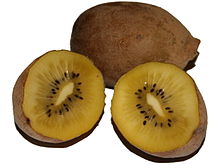
Gold Kiwifruit, "Hinabelle" or Zespri, with yellow flesh and a sweeter, less acidic flavor resembling a tropical fruit salad, is a new cultivar group produced by the New Zealand Crown Research Institute, Plant & Food Research and marketed worldwide in increasing volumes. Some wild vines in India, having small yellow fruit, have not been commercially exploited, but are now being successfully cultivated in the Indian state of Himachal Pradesh.
Seeds from these plants were imported to New Zealand in 1987 and the company took 11 years to develop the new fruit through cross-pollination and grafting with green kiwifruit vines. Zespri have a smooth, bronze skin, a pointed cap at one end and distinctive golden yellow flesh with a less tart and more tropical flavor than green kiwifruit. It has a higher market price than green kiwifruit. It is less hairy than the green cultivars, so can be eaten whole after rubbing off the thin, fluffy coat. While the skin of kiwifruit is often removed before serving, it is completely edible.
Nutrition
Kiwifruit is a rich source of vitamin C, 1.5 times the DRI scale in the US. Its potassium content by weight is slightly less than that of a banana. It also contains vitamin E, and a small amount of vitamin A. The skin is a good source of flavonoid antioxidants. The kiwifruit seed oil contains on average 62% alpha-linolenic acid, an omega-3 fatty acid. Usually a medium size kiwifruit contains about 46 calories, 0.3 g fats, 1 g protein, 11 g carbohydrates, 75 mg vitamins and 2.6 g dietary fiber. Kiwifruit is often reported to have mild laxative effects, due to the high level of dietary fiber.
Raw kiwifruit is also rich in the protein-dissolving enzyme actinidin, (in the same family of thiol proteases as papain), which is commercially useful as a meat tenderizer but can be an allergen for some individuals. Specifically, people allergic to latex, papayas or pineapples are likely to also be allergic to kiwifruit. The fruit also contains calcium oxalate crystals in the form of raphides. Reactions to these chemicals include sweating, tingling and sore mouth or throat; swelling of the lips, tongue and face; rash; vomiting and abdominal pain, heartburn; and, in the most severe cases, breathing difficulties, wheezing and collapse. The most common symptoms are unpleasant itching and soreness of the mouth, with the most common severe symptom being wheezing. Severe symptoms are most likely to occur in young children.
Actinidin also makes raw kiwifruit unsuitable for use in desserts containing milk or any other dairy products which are not going to be served within hours, because the enzyme soon begins to digest milk proteins. This applies to gelatin-based desserts as well, as the actinidin will dissolve the collagen proteins in gelatin very quickly, either liquifying the dessert, or preventing it from solidifying. However, the U.S. Department of Agriculture suggests that cooking the fruit for a few minutes before adding it to the gelatin will overcome this effect. Sliced kiwifruit has long been regularly used as a garnish atop whipped cream on New Zealand's national dessert, the pavlova. It can also be used in curry.
Kiwifruit components, possibly involving vitamin E and omega-3 fatty acids from its numerous edible seeds, have potential properties of a natural blood thinner. A study performed at the University of Oslo in Norway revealed that—similar to popular mainstream aspirin therapy—consuming two to three kiwifruit daily for 28 days significantly reduced platelet aggregation and blood triglyceride levels, potentially reducing the risk of blood clots.
The kiwifruit skin is edible and contains high amounts of dietary fiber. In a fully matured kiwifruit one study showed that this as much as tripled the fiber content of the fruit. In addition, as many of the vitamins are stored immediately under the skin, leaving the skin intact greatly increases the vitamin C consumed by eating a single piece of kiwifruit when compared to eating it peeled. As with all fruit, it is recommended that if eating the skin, the fruit be washed prior to consumption. Kiwifruit is a natural source of carotenoids, such as beta-carotene, lutein and zeaxanthin.
Kiwifruit, fresh, raw : Nutritional value per 100 g (3.5 oz)
Energy 255 kJ (61 kcal) | Carbohydrates 14.66 g
Sugars 8.99 g | Dietary fiber 3.0 g | Fat 0.52 g
Protein 1.14 g | - lutein and zeaxanthin 122 μg
Thiamine (Vit. B1) 0.027 mg (2%)
Riboflavin (Vit. B2) 0.025 mg (2%)
Niacin (Vit. B3) 0.341 mg (2%) | Vitamin B6 0.63 mg (48%)
Folate (Vit. B9) 25 μg (6%) | Vitamin C 92.7 mg (155%)
Vitamin E 1.5 mg (10%) | Vitamin K 40.3 μg (38%)
Calcium 34 mg (3%) | Iron 0.31 mg (2%)
Magnesium 17 mg (5%) | Manganese 0.098 mg
Phosphorus 34 mg (5%) | Potassium 312 mg (7%)
Sodium 3 mg (0%) | Zinc 0.14 mg (1%)
Percentages are relative to US recommendations for adults.
Source: USDA Nutrient database


Source, Images: http://en.wikipedia.org/wiki/Kiwifruit

Sunday, November 14, 2010

Healthy Fruit: Grapefruit

The grapefruit (Citrus × paradisi), is a subtropical citrus tree known for its bitter fruit, an 18th-century hybrid first bred in Barbados. When found it was named the "forbidden fruit"; it has also been misidentified with the pomelo or shaddock (C. maxima), one of the parents of this hybrid, the other being sweet orange (C. × sinensis).
These evergreen trees are usually found at around 5–6 metres (16–20 ft) tall, although they can reach 13–15 metres (43–49 ft). The leaves are dark green, long (up to 150 mm, or 6 inches) and thin. It produces 5 cm (2 in) white four-petaled flowers. The fruit is yellow-orange skinned and largely an oblate spheroid; it ranges in diameter from 10–15 cm. The flesh is segmented and acidic, varying in color depending on the cultivars, which include white, pink and red pulps of varying sweetness. The 1929 US Ruby Red (of the Redblush variety) has the first grapefruit patent.
The fruit has become popular since the late 19th century; before that it was only grown as an ornamental plant. The United States quickly became a major producer of the fruit, with orchards in Florida, Texas, Arizona, and California. In Spanish, the fruit is known as toronja or pomelo.
Grapefruit comes in many varieties, determinable by color, which is caused by the pigmentation of the fruit in respect of both its state of ripeness. The most popular varieties cultivated today are red, white, and pink hues, referring to the internal pulp color of the fruit. The family of flavors range from highly acidic and somewhat bitter to sweet and tart. Grapefruit mercaptan, a sulfur-containing terpene, is one of the substances which has a strong influence on the taste and odor of grapefruit, compared with other citrus fruits.
Grapefruit is an excellent source of many nutrients and phytochemicals that contribute to a healthy diet. Grapefruit is a good source of vitamin C, contains the fiber pectin, and the pink and red hues contain the beneficial antioxidant lycopene. Studies have shown grapefruit helps lower cholesterol, and there is evidence that the seeds have antioxidant properties. Grapefruit forms a core part of the "grapefruit diet", the theory being that the fruit's low glycemic index is able to help the body's metabolism burn fat.
Grapefruit seed extract (GSE) has been claimed to have strong antimicrobial properties, with proven activity against bacteria and fungi. However, no studies have demonstrated any efficacy by GSE as an antimicrobial for either bacteria or fungi. Additionally, although GSE is promoted as a highly effective plant-based preservative by some natural personal care manufacturers, studies have shown that the apparent antimicrobial activity associated with GSE preparations is merely due to contamination with synthetic preservatives.
Since grapefruit juice is known to inhibit enzymes necessary for the clearance of some drugs and hormones, some have hypothesized that grapefruit juice may play an indirect role in the development of hormone-dependent cancers. A 2007 study found a correlation between eating a quarter of grapefruit daily and a 30% increase in risk for breast cancer in post-menopausal women. The study points to the inhibition of CYP3A4 enzyme by grapefruit, which metabolizes estrogen. However, a 2008 study has shown that grapefruit consumption does not increase breast cancer risk and found a significant decrease in breast cancer risk with greater intake of grapefruit in women who never used hormone therapy.
Grapefruit contains large quantities of a simple polyamine called spermidine, which may be related to aging. It is known to be necessary for cell growth and maturation, and as cells age their level of spermidine is known to fall. Scientists have shown that feeding spermidine to worms, fruit flies and yeast significantly prolongs their lifespan. In addition, adding spermidine to the diet of mice decreased molecular markers of aging, and when human immune cells were cultured in a medium containing spermidine, they also lived longer.
A number of studies have found a risk for kidney stones from drinking grapefruit juice. In one study, just one 8-ounce cup of grapefruit juice per day increased the risk for forming stones by 44%. Grapefruit peel oil is used in aromatherapy and it is historically known for its aroma.
In Costa Rica, especially in Atenas, grapefruits are often cooked to remove their sourness, rendering them as sweets; they are also stuffed with dulce de leche, resulting in a dessert called toronja rellena (stuffed grapefruit). It is also known as pomelo in the Philippines.
Grapefruit has also been investigated in cancer medicine pharmacodynamics. Its inhibiting effect on the metabolism of some drugs may allow smaller doses to be used, which can help to reduce costs. Grapefruit is used as a natural laxative, as it stimulates defecation (especially true for pink grapefruit).
Grapefruit, raw, white, all areas : Nutritional value per 100 g (3.5 oz)
Energy 138 kJ (33 kcal) | Carbohydrates 8.41 g
Sugars 7.31 g | Dietary fiber 1.1 g
Fat 0.10 g | Protein 0.69 g | Water 90.48 g
Thiamine (Vit. B1) 0.037 mg (3%)
Riboflavin (Vit. B2) 0.020 mg (1%)
Niacin (Vit. B3) 0.269 mg (2%)
Pantothenic acid (B5) 0.283 mg (6%)
Vitamin B6 0.043 mg (3%) | Folate (Vit. B9) 10 μg (3%)
Vitamin C 33.3 mg (56%) | Calcium 12 mg (1%)
Iron 0.06 mg (0%) | Magnesium 9 mg (2%)
Manganese 0.013 mg | Phosphorus 8 mg (1%)
Potassium 148 mg (3%) | Zinc 0.07 mg (1%)
Percentages are relative to US recommendations for adults.
Source: USDA Nutrient database


Source, Images: http://en.wikipedia.org/wiki/Grapefruit