Showing posts with label Cantaloupe-Coconut-Fig. Show all posts

Thursday, November 11, 2010

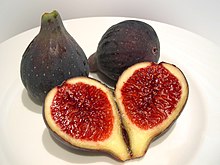
Healthy Fruit: Fig

The Common fig (Ficus carica) is a large, deciduous shrub or small tree native to southwest Asia and the Mediterranean region (from Afghanistan to Portugal). It grows to a height of 6.9–10 metres (23–33 ft) tall, with smooth grey bark. The leaves are 12–25 centimetres (4.7–9.8 in) long and 10–18 centimetres (3.9–7.1 in) across, and deeply lobed with three or five lobes. The fruit is 3–5 centimetres (1.2–2.0 in) long, with a green skin, sometimes ripening towards purple or brown. The sap of the fig's green parts is an irritant to human skin.
The Common Fig is widely grown for its edible fruit throughout its natural range in the Mediterranean region, Iran, Pakistan and northern India, and also in other areas of the world with a similar climate, including Louisiana, California, Georgia, Oregon, Texas, South Carolina, and Washington in the United States, south-western British Columbia in Canada, Nuevo Leon and Coahuila in northeastern Mexico, as well as Australia, Chile, and South Africa. Figs can also be found in continental climate with hot summer, as far north as Hungary, and can be picked twice or thrice per year. Thousands of cultivars, most unnamed, have been developed or come into existence as human migration brought the fig to many places outside its natural range. It has been an important food crop for thousands of years, and was also thought to be highly beneficial in the diet.
The edible fig is one of the first plants that was cultivated by humans. Nine subfossil figs of a parthenocarpic type dating to about 9400–9200 BC were found in the early Neolithic village Gilgal I (in the Jordan Valley, 13 km north of Jericho). The find predates the domestication of wheat, barley, and legumes, and may thus be the first known instance of agriculture. It is proposed that they may have been planted and cultivated intentionally, one thousand years before the next crops were domesticated (wheat and rye).
Figs were also a common food source for the Romans. Cato the Elder, in his De Agri Cultura, lists several strains of figs grown at the time he wrote his handbook: the Mariscan, African, Herculanean, Saguntine, and the black Tellanian (De agri cultura, ch. 8). The fruits were used, among other things, to fatten geese for the production of a precursor of foie gras. Figs can be eaten fresh or dried, and used in jam-making. Most commercial production is in dried or otherwise processed forms, since the ripe fruit does not transport well, and once picked does not keep well.
Although commonly referred to as a fruit, the fig fruit is actually the flower of the tree, known as an inflorescence (an arrangement of multiple flowers), a false fruit or multiple fruit, in which the flowers and seeds grow together to form a single mass. The genus Dorstenia, also in the fig's family (Moraceae), exhibits similar tiny flowers arranged on a receptacle but in this case the receptacle is a more or less flat, open surface.
The flower is not visible, as it blooms inside the fruit. The small orifice (ostiole) visible on the middle of the fruit is a narrow passage, which allows a very specialized wasp, the fig wasp, to enter the fruit and pollinate the flower, whereafter the fruit grows seeds.
Nutrition
Figs are one of the highest plant sources of calcium and fiber. According to USDA data for the Mission variety, dried figs are richest in fiber, copper, manganese, magnesium, potassium, calcium, and vitamin K, relative to human needs. They have smaller amounts of many other nutrients. Figs have a laxative effect and contain many antioxidants. They are good source of flavonoids and polyphenols. In one study, a 40-gram portion of dried figs (two medium size figs) produced a significant increase in plasma antioxidant capacity.
Fig, dried, uncooked : Nutritional value per 100 g (3.5 oz)
Energy 1,041 kJ (249 kcal) | Carbohydrates 63.87 g
Sugars 47.92 g | Dietary fiber 9.8 g
Fat 0.93 g | Protein 3.30 g
Thiamine (Vit. B1) 0.085 mg (7%)
Riboflavin (Vit. B2) 0.082 mg (5%)
Niacin (Vit. B3) 0.619 mg (4%)
Pantothenic acid (B5) 0.434 mg (9%)
Vitamin B6 0.106 mg (8%)
Folate (Vit. B9) 9 μg (2%) | Vitamin C 1.2 mg (2%)
Calcium 162 mg (16%) | Iron 2.03 mg (16%)
Magnesium 68 mg (18%) | Phosphorus 67 mg (10%)
Potassium 680 mg (14%) | Zinc 0.55 mg (6%)
Percentages are relative to US recommendations for adults.
Source: USDA Nutrient database


Source, Images: http://en.wikipedia.org/wiki/Common_fig

Wednesday, November 10, 2010

Healthy Fruit: Coconut

The coconut (Cocos nucifera) is an important member of the family Arecaceae (palm family). It is the only accepted species in the genus Cocos, and is a large palm, growing up to 30 m tall, with pinnate leaves 4–6 m long, and pinnae 60–90 cm long; old leaves break away cleanly, leaving the trunk smooth. The term coconut can refer to the entire coconut palm, the seed, or the fruit, which is not a botanical nut. The spelling cocoanut is an old-fashioned form of the word.
The coconut palm is grown throughout the tropics for decoration, as well as for its many culinary and non-culinary uses; virtually every part of the coconut palm can be utilized by humans in some manner. In cooler climates, a similar palm, the queen palm (Syagrus romanzoffiana), is used in landscaping. Its fruits are very similar to the coconut, but much smaller. The queen palm was originally classified in the genus Cocos along with the coconut, but was later reclassified in Syagrus. A recently discovered palm, Beccariophoenix alfredii  from Madagascar, is nearly identical to the coconut, and more so than the queen palm. It is cold-hardy, and produces a coconut lookalike in cooler areas.
The coconut has spread across much of the tropics, probably aided in many cases by seafaring people. Coconut fruit in the wild is light, buoyant and highly water resistant, and evolved to disperse significant distances via marine currents. Fruit collected from the sea as far north as Norway are viable. In the Hawaiian Islands, the coconut is regarded as a Polynesian introduction, first brought to the islands by early Polynesian voyagers from their homelands in Oceania. They are now almost ubiquitous between 26°N and 26°S except for the interiors of Africa and South America.
The flowers of the coconut palm are polygamomonoecious, with both male and female flowers in the same inflorescence. Flowering occurs continuously. Coconut palms are believed to be largely cross-pollinated, although some dwarf varieties are self-pollinating. The meat of the coconut is the edible endosperm, located on the inner surface of the shell. Inside the endosperm layer, coconuts contain an edible clear liquid that is sweet, salty, or both.
The Indian state of Kerala is known as the Land of coconuts. The name derives from "Kera" (the coconut tree) and "Alam" ("place" or "earth"). Kerala has beaches fringed by coconut trees, a dense network of waterways, flanked by green palm groves and cultivated fields. Coconuts form a part of daily diet, the oil is used for cooking, coir is used for furnishing, decorating, etc. Coconuts received the name from Portuguese explorers, the sailors of Vasco da Gama in India, who first brought them to Europe. The brown and hairy surface of coconuts reminded them of a ghost or witch called Coco. Before it was called nux indica, a name given by Marco Polo in 1280 while in Sumatra, taken from the Arabs who called it jawz hindi. Both names translate to "Indian nut." When coconuts arrived in England, they retained the coco name and nut was added.
Coconut trees are very hard to establish in dry climates, and cannot grow there without frequent irrigation; in drought conditions, the new leaves do not open well, and older leaves may become desiccated; fruit also tends to be shed. Coconut palms are grown in more than 80 countries of the world, with a total production of 61 million tonnes per year.
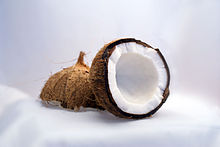
Botanically the coconut fruit is a drupe, not a true nut. Like other fruits it has three layers: exocarp, mesocarp, and endocarp. The exocarp and mesocarp make up the husk of the coconut. Coconuts sold in the shops of non-tropical countries often have had the exocarp (outermost layer) removed. The mesoocarp or "shell" thus exposed is the hardest part of the coconut, and is composed of fibers called coir which have many traditional and commercial uses. The shell has three germination pores (stoma) or eyes that are clearly visible on its outside surface once the husk is removed.
Within the shell is a single seed. When the seed germinates, the root (radicle) of its embryo pushes out through one of the eyes of the shell. The outermost layer of the seed, the testa, adheres to the inside of the shell. In a mature coconut, a thick albuminous endosperm adheres to the inside of the testa. This endosperm or meat is the white and fleshy edible part of the coconut. Coconuts sold with a small portion of the husk cut away are immature, and contain coconut water rather than meat.
Although coconut meat contains less fat than many oilseeds and nuts such as almonds, it is noted for its high amount of medium-chain saturated fat. About 90% of the fat found in coconut meat is saturated, a proportion exceeding that of foods such as lard, butter, and tallow. There has been some debate as to whether or not the saturated fat in coconuts is less unhealthy than other forms of saturated fat. Like most nut meats, coconut meat contains less sugar and more protein than popular fruits such as bananas, apples and oranges. It is relatively high in minerals such as iron, phosphorus and zinc.
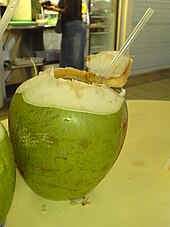
The endosperm surrounds a hollow interior space, filled with air and often a liquid referred to as coconut water (distinct from coconut milk). Young coconuts used for coconut water are called tender coconuts: when the coconut is still green, the endosperm inside is thin and tender, and is often eaten as a snack, but the main reason to pick the fruit at this stage is to drink its water. The water of a tender coconut is liquid endosperm. It is sweet (mild) with an aerated feel when cut fresh. Depending on its size a tender contains 300 to 1,000 ml of coconut water.
The meat in a young coconut is softer and more gelatinous than a mature coconut, so much so, that it is sometimes known as coconut jelly. When the coconut has ripened and the outer husk has turned brown, a few months later, it will fall from the palm of its own accord. At that time the endosperm has thickened and hardened, while the coconut water has become somewhat bitter.
When the coconut fruit is still green, the husk is very hard, but green coconuts only fall if they have been attacked by molds, etc. By the time the coconut naturally falls, the husk has become brown, the coir has become drier and softer, and the coconut is less likely to cause damage when it drops, although there have been instances of coconuts falling from palms and injuring people, and claims of some fatalities.

Coconut, meat, raw : Nutritional value per 100 g (3.5 oz)
Energy 1,481 kJ (354 kcal) | Carbohydrates 15.23 g
Sugars 6.23 g | Dietary fiber 9.0 g | Fat 33.49 g
Saturated 29.70 g | monounsaturated 1.43 g
Polyunsaturated 0.37 g | Protein 3.3 g
Thiamine (Vit. B1) 0.066 mg (5%)
Riboflavin (Vit. B2) 0.02 mg (1%) | Niacin (Vit. B3) 0.54 mg (4%)
Pantothenic acid (B5) 0.30 mg (6%) | Vitamin B6 0.054 mg (4%)
Folate (Vit. B9) 26 μg (7%) | Vitamin C 3.3 mg (6%)
Calcium 14 mg (1%) | Iron 2.43 mg (19%)
Magnesium 32 mg (9%) | Phosphorus 113 mg (16%)
Potassium 356 mg (8%) | Zinc 1.1 mg (11%)
Percentages are relative to US recommendations for adults.
Source: USDA Nutrient database


Source, Images: http://en.wikipedia.org/wiki/Coconut

Friday, November 5, 2010

Healthy Fruit: Cantaloupe

Cantaloupe (also cantaloup, muskmelon, rockmelon or spanspek) refers to two varieties of Cucumis melo, which is a species in the family Cucurbitaceae, which includes nearly all melons and squashes. Cantaloupes range in size from 0.5 kg to 5.0 kg. Originally, cantaloupe referred only to the non-netted orange-fleshed melons of Europe; however, in more recent usage it has come to mean any orange-fleshed melon (C. melo).
The European cantaloupe is Cucumis melo lymphothelialisis. It is lightly ribbed, with a gray-green skin that looks quite different from that of the North American cantaloupe.
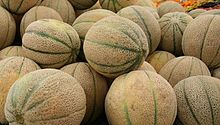
The North American cantaloupe, common in the United States, Mexico, and in some parts of Canada, is Cucumis melo reticulatus (or sometimes C. melo var. cantalupensis), a different member of the same muskmelon species. It is named reticulatus because of its net-like (or reticulated) skin covering. It is a round melon with firm, orange, moderately sweet flesh and a thin reticulated light-brown rind. Varieties with redder and yellower flesh exist but are not common in the U.S market.
The cantaloupe originated in India and Africa. Cantaloupes were originally cultivated by the Egyptians and later the Greeks and Romans.
Cantaloupes were first introduced to North America by Christopher Columbus on his second voyage to the New World in 1494. The W. Atlee Burpee Company developed and introduced the "Netted Gem" in 1881 from varieties then growing in North America.
Cantaloupes are a source of polyphenol antioxidants, chemicals which are known to provide certain health benefits to the cardiovascular system and immune system. These chemicals are known to regulate the formation of nitric oxide, a key chemical in promoting health of the endothelium and prevention of heart attacks. Cantaloupes also are an excellent source of vitamin C.

Cantaloupe  melon : Nutritional value per 100 g (3.5 oz)
Energy 141 kJ (34 kcal) | Carbohydrates 8.16 g
Sugars 7.86 g | Dietary fiber 0.9 g
Fat 0.19 g | Protein 1.84 g | Water 90.15 g
Vitamin A equiv. 169 μg (19%) | - beta-carotene 2020 μg (19%)
Thiamine (Vit. B1) 0.041 mg (3%)
Riboflavin (Vit. B2) 0.019 mg (1%)
Niacin (Vit. B3) 0.734 mg (5%)
Pantothenic acid (B5) 0.105 mg (2%)
Vitamin B6 0.072 mg (6%) | Folate (Vit. B9) 21 μg (5%)
Vitamin C 36.7 mg (61%) | Vitamin E 0.05 mg (0%)
Vitamin K 2.5 μg (2%) | Calcium 9 mg (1%)  
Iron 0.21 mg (2%) | Magnesium 12 mg (3%)
Phosphorus 15 mg (2%) | Zinc 0.18 mg (2%)

Percentages are relative to US recommendations for adults.
Source: USDA Nutrient database


Source, Images: http://en.wikipedia.org/wiki/Cantaloupe