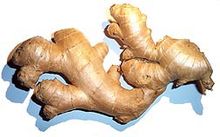
 Ginger is a tuber that is consumed whole as a delicacy, medicine, or spice. It is the rhizome of the plant Zingiber officinale. It lends its name to its genus and family (Zingiberaceae). Other notable members of this plant family are turmeric, cardamom, and galangal.
Ginger cultivation began in South Asia and has since spread to East Africa and the Caribbean. It is sometimes called root ginger to distinguish it from other things that share the name ginger.
The English name ginger comes from French: gingembre, Old English: gingifere, Medieval Latin: ginginer.
 The characteristic odor and flavor of ginger is caused by a mixture of zingerone, shogaols and gingerols, volatile oils that compose one to three percent of the weight of fresh ginger. In laboratory animals, the gingerrols increase the motility of the gastrointestinal tract and have analgesic, sedative, antipyretic and antibacterial properties. Ginger oil has been shown to prevent skin cancer in mice and a study at the University of Michigan demonstrated that gingerols can kill ovarian cancer cells.
Ginger contains up to three percent of a fragrant essential oil whose main constituents are sesquiterpenoids, with (-)-zingiberene as the main component. Smaller amounts of other sesquiterpenoids (β-sesquiphellandrene, bisabolene and farnesene) and a small monoterpenoid fraction (β-phelladrene, cineol, and citral) have also been identified.
 The pungent taste of ginger is due to nonvolatile phenylpropanoid-derived compounds, particularly gingerols and shogaols, which form from gingerols when ginger is dried or cooked. Zingerone is also produced from gingerols during this process; this compound is less pungent and has a spicy-sweet aroma. Ginger is also a minor chemical irritant, and because of this was used as a horse suppository by pre-World War I mounted regiments for feaguing.
Ginger has a sialagogue action, stimulating the production of saliva, which makes swallowing easier.
Culinary Use
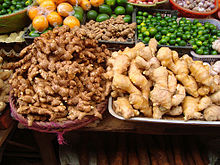
Young ginger rhizomes are juicy and fleshy with a very mild taste. They are often pickled in vinegar or sherry as a snack or just cooked as an ingredient in many dishes. They can also be steeped in boiling water to make ginger tea, to which honey is often added; sliced orange or lemon fruit may also be added. Ginger can also be made into candy.
Mature ginger roots are fibrous and nearly dry. The juice from old ginger roots is extremely potent, and is often used as a spice in Indian recipes, and is a quintessential ingredient of Chinese, Japanese and many South Asian cuisines for flavoring dishes such as seafood or goat meat and vegetarian cuisine. Ginger acts as a useful food preservative.

Fresh ginger may be peeled before eating. For longer-term storage, the ginger can be placed in a plastic bag and refrigerated or frozen.
Regional Use
 In India, ginger is called Aadrak. Fresh ginger is one of the main spices used for making pulse and lentil curries and other vegetable preparations. Fresh, as well as dried, ginger is used to spice tea and coffee, especially in winter. Ginger powder is also used in certain food preparations, particularly for pregnant or nursing women, the most popular one being Katlu which is a mixture of gum resin, ghee, nuts, and sugar. Ginger is also consumed in candied and pickled form.
In Bangladesh, ginger is called Aadha and is finely chopped or ground into a paste to use as a base for chicken and meat dishes alongside shallot and garlic.
In the Philippines, ginger is called luya and is used as "candy" when there is sore throat or hoarse voice.
In Burma, ginger is called gyin. It is widely used in cooking and as a main ingredient in traditional medicines. It is also consumed as a salad dish called gyin-thot, which consists of shredded ginger preserved in oil, and a variety of nuts and seeds.

In Nepal, ginger is called "aduwa" and is widely grown and used throughout the country as a spice for vegetables, used medically to treat cold and also sometimes used to flavor tea.
In Vietnam, the fresh leaves, finely chopped, can also be added to shrimp-and-yam soup as a top garnish and spice to add a much subtler flavor of ginger than the chopped root.
 In China, sliced or whole ginger root is often paired with savory dishes such as fish, and chopped ginger root is commonly paired with meat, when it is cooked. However, candied ginger is sometimes a component of Chinese candy boxes, and a herbal tea can also be prepared from ginger.
In Japan, ginger is pickled to make beni shoga and gari or grated and used raw on tofu or noodles. It is also made into a candy called shoga no satozuke.
In the traditional Korean kimchi, ginger is finely minced and added to the ingredients of the spicy paste just before the fermenting process.
In Western cuisine, ginger is traditionally used mainly in sweet foods such as ginger ale, gingerbread, ginger snaps, parkin, ginger biscuits and speculaas. A ginger-flavored liqueur called Canton is produced in Jarnac, France. Green ginger wine is a ginger-flavored wine produced in the United Kingdom, traditionally sold in a green glass bottle. Ginger is also used as a spice added to hot coffee and tea.
 In the Caribbean, ginger is a popular spice for cooking, and making drinks such as sorrel, a seasonal drink made during the Christmas season. Jamaicans make ginger beer both as a carbonated beverage and also fresh in their homes. Ginger tea is often made from fresh ginger, as well as the famous regional specialty Jamaican ginger cake.
On the island of Corfu, Greece, a traditional drink called tsitsibira, a type of ginger beer, is made. The people of Corfu and the rest of the Ionian islands adopted the drink from the British, during the period of the United States of the Ionian Islands.
In Arabic, ginger is called zanjabil, and in some parts of the Middle East, ginger powder is used as a spice for coffee and for milk, as well. In Somaliland, ginger is called sinjibil, and is served in coffee shops in Egypt.
In the Ivory Coast, ginger is ground and mixed with orange, pineapple and lemon to produce a juice called nyamanku.
Medicinal use

The medical form of ginger historically was called Jamaica ginger; it was classified as a stimulant and carminative and used frequently for dyspepsia, gastroparesis, slow motility symptoms, constipation, and colic. It was also frequently employed to disguise the taste of medicines. Ginger is on the FDA's "generally recognized as safe" list, though it does interact with some medications, including warfarin. Ginger is contraindicated in people suffering from gallstones as it promotes the production of bile. Ginger may also decrease pain from arthritis, though studies have been inconsistent, and may have blood thinning and cholesterol lowering properties that may make it useful for treating heart disease. An acute overdose of ginger is usually in excess of about 2,000 milligrams per kilogram, dependent on level of ginger tolerance, and can result in a state of central nervous system over-stimulation called ginger intoxication or colloquially the "ginger gitters".
Ginger compounds are active against a form of diarrhea which is the leading cause of infant death in developing countries. Zingerone is likely to be the active constituent against enterotoxigenic Escherichia coli heat-labile enterotoxin-induced diarrhea.
 Ginger has been found effective in multiple studies for treating nausea caused by seasickness, morning sickness and chemotherapy, though ginger was not found superior over a placebo for pre-emptively treating post-operative nausea. Ginger is a safe remedy for nausea relief during pregnancy. Ginger as a remedy for motion sickness is still a debated issue. The television program Mythbusters performed an experiment using one of their staff who suffered from severe motion sickness. The staff member was placed in a moving device which, without treatment, produced severe nausea. Multiple treatments were administered. None, with the exception of the ginger and the two most common drugs, were successful. The staff member preferred the ginger due to lack of side effects. Several studies over the last 20 years were inconclusive with some studies in favor of the herb and some not. A common thread in these studies is the lack of sufficient participants to yield statistical significance. Another issue is the lack of a known chemical pathway for the supposed relief.
Folk medicine
 A variety of uses are suggested for ginger. Tea brewed from ginger is a folk remedy for colds. Three to four leaves of tulsi taken with a piece of ginger on an empty stomach is considered an effective cure for congestion, cough and cold. Ginger ale and ginger beer have been recommended as stomach settlers for generations in countries where the beverages are made, and ginger water was commonly used to avoid heat cramps in the United States. In China, "ginger eggs" (scrambled eggs with finely diced ginger root) is a common home remedy for coughing. The Chinese also make a kind of dried ginger candy that is fermented in plum juice and sugared, which is also commonly consumed to suppress coughing. Ginger has also been historically used to treat inflammation, which several scientific studies support, though one arthritis trial showed ginger to be no better than a placebo or ibuprofen for treatment of osteoarthritis. Research on rats suggests that ginger may be useful for treating diabetes.
Regional medicinal use
 The West, powdered dried ginger root is made into capsules and sold in pharmacies for medicinal use.
- In Burma, ginger and a local sweetener made from palm tree juice (htan nyat) are boiled together and taken to prevent the flu.
- In China, ginger is included in several traditional preparations. A drink made with sliced ginger cooked in water with brown sugar or a cola is used as a folk medicine for the common cold.
- In Congo, ginger is crushed and mixed with mango tree sap to make tangawisi juice, which is considered a panacea.
- In India, ginger is applied as a paste to the temples to relieve headache, and consumed when suffering from the common cold. Ginger with lemon and black salt is also used for nausea.
- In Indonesia, ginger ("jahe" in Indonesian) is used as a herbal preparation to reduce fatigue, reducing "winds" in the blood, prevent and cure rheumatism and control poor dietary habits.
- In the Philippines a traditional health drink called "salabat" is made for breakfast by boiling chopped ginger and adding sugar; it is considered good for a sore throat.
- In the United States, ginger is used to prevent motion and morning sickness. It is recognized as safe by the Food and Drug Administration and is sold as an unregulated dietary supplement.
- In Peru, ginger is sliced in hot water as an infusion for stomach aches as "infusión de Kión"
Reactions
 Allergic reactions to ginger generally result in a rash, and although generally recognized as safe, ginger can cause heartburn, bloating, gas, belching and nausea, particularly if taken in powdered form. Un-chewed fresh ginger may result in intestinal blockage, and individuals who have had ulcers, inflammatory bowel disease or blocked intestines may react badly to large quantities of fresh ginger. Ginger can also adversely affect individuals with gallstones. There are also suggestions that ginger may affect blood pressure, clotting, and heart rhythms.
Reference: http://en.wikipedia.org/wiki/Ginger











.jpg/220px-East_Meets_West_Pasta_(3469451959).jpg)