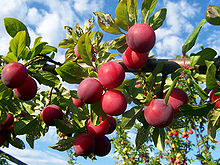
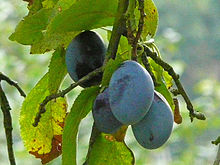
A Plum or gage is a stone fruit tree in the genus Prunus, subgenus Prunus. The subgenus is distinguished from other subgenera (peaches, cherries, bird cherries, etc.) in the shoots having a terminal bud and the side buds solitary (not clustered), the flowers in groups of one to five together on short stems, and the fruit having a groove running down one side and a smooth stone (or pit).
Mature plum fruit may have a dusty-white coating that gives them a glaucous appearance and is easily rubbed off. This is an epicuticular wax coating and is known as "wax bloom". Dried plum fruits are called dried plums or prunes, although prunes are a distinct type of plum, and may have pre-dated the fruits now commonly known as plums.
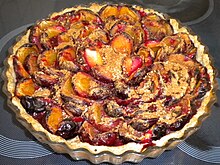
Plum fruit tastes sweet and/or tart; the skin may be particularly tart. It is juicy and can be eaten fresh or used in jam-making or other recipes. Plum juice can be fermented into plum wine; when distilled, this produces a brandy known in Eastern Europe as Slivovitz, Rakia, Tuica or Palinka. Dried plums (or prunes) are also sweet and juicy and contain several antioxidants. Plums and prunes are known for their laxative effect. This effect has been attributed to various compounds present in the fruits, such as dietary fiber, sorbitol, and isatin. Prunes and prune juice are often used to help regulate the functioning of the digestive system. As with many other members of the rose family, plum seeds contain cyanogenic glycosides, including amygdalin. These substances are capable of decomposing into a sugar molecule and hydrogen cyanide gas. While plum seeds are not the most toxic within the rose family—that dubious honor going to the bitter almond—large doses of these chemicals from any source are hazardous to human health. Dried prune marketers in the United States have, in recent years, begun marketing their product as "dried plums". This is due to "prune" having negative connotations connected with elderly people suffering from constipation. Dried, salted plums are used as a snack, sometimes known as salaito or salao. Various flavors of dried plum are available at Chinese grocers and specialty stores worldwide. They tend to be much drier than the standard prune. Cream, Ginsing, Spicy, and Salty are among the common varieties. Licorice is generally used to intensify the flavor of these plums and is used to make salty plum drinks and toppings for Shaved Ice or baobing.
 Pickled plums are another type of preserve available in Asia and international specialty stores. The Japanese variety, called umeboshi, is often used for rice balls, called "Onigiri" or "Omusubi". The ume, from which umeboshi are made, is however more closely related to the apricot than to the plum. Prune kernel oil is made from the fleshy inner part of the pit of the plum.
Plums come in a wide variety of colors and sizes. Some are much firmer-fleshed than others and some have yellow, white, green or red flesh, with equally varying skin color. Plum cultivars in use today include:
Greengage (Firm, green flesh and skin even when ripe.)
Mirabelle (Dark yellow, predominantly grown in northeast France.)
Satsuma plum (Firm red flesh with a red skin.)
'Victoria' (Yellow flesh with a red or mottled skin.) Yellowgage, or Golden plum (Similar to Greengage, but yellow.)
When it flowers in the early spring, a plum tree will be covered in blossom, and in a good year approximately 50% of the flowers will be pollinated and become plums. Flowering starts after 80 growing degree days.
If the weather is too dry the plums will not develop past a certain stage, but will fall from the tree while still tiny green buds, and if it is unseasonably wet or if the plums are not harvested as soon as they are ripe, the fruit may develop a fungal condition called brown rot. Brown rot is not toxic, and very small affected areas can be cut out of the fruit, but unless the rot is caught immediately the fruit will no longer be edible. Plum is used as a food plant by the larvae of some Lepidoptera including November Moth, Willow Beauty and Short-cloaked Moth.  A large number of plums are also grown in Hungary where they are called szilva and are used to make lekvar (a plum paste jam), palinka (a slivovitz-type liquor), plum dumplings, and other foods. The region of Szabolcs-Szatmar, in the northeastern part of the country near the borders with Ukraine and Romania, is a major producer of plums. The plum is commonly used in China, Yunnan area, to produce a local plum wine with a smooth, sweet, fruity taste and approximately 12% alcohol by volume.
Plums (without pit) Prunes spp.
Nutritional value per 100 g (3.5 oz)
Energy 192 kJ (46 kcal) | Carbohydrates 11.4 g
Sugars 9.9 g | Dietary fiber 1.4 g
Fat 0.28 g | Protein 0.70 g
Vitamin A 345 IU | Vitamin C 9.5 mg (16%)
Phosphorus 16 mg (2%) | Potassium 157 mg (3%)
1 fruit (2-1/8" dia) 66 g
1 cup, sliced 165 g
Percentages are relative to US recommendations for adults.
Source: USDA Nutrient database
A Prune is any of various plum species, mostly Prunus domestica or European Plum. It is called 'Alu-bukhara' in India, Pakistan and Bangladesh. They are usually sold as dried fruit. The dried fruit (also referred to as a dried plum) is wrinkly in texture, and has chewy flesh. Fresh plums that are marketed as "prunes" have an oval shape and a more easily removed pit.  More than 1,000 cultivars of plums are grown for drying. The main cultivar grown in the US is the Improved French prune. Other varieties include Sutter, Tulare Giant, Moyer, Imperial, Italian, and Greengage. In general, fresh prunes are freestone cultivars (the pit is easy to remove), whereas most other plums grown for fresh consumption are cling (the pit is more difficult to remove). Fresh prunes reach the market earlier than fresh plums and are usually smaller in size.
Due to popular perception of prunes being used for constipation in older people, and being the subject of related distasteful joking, many of today's distributors have stopped using the word on the package label. Their preference is to state "dried plums".
Prunes are used in cooking both sweet and savory dishes. Stewed prunes, a compote, are a dessert. Prunes are a frequent ingredient in North African tagines. Perhaps the best-known gastronomic prunes are those of Agen (pruneaux d'Agen). Prunes are used frequently in Tzimmes, a traditional Jewish dish in which the principal ingredient is diced or sliced carrots; and in the traditional Norwegian desserts fruktsuppe and sviskekompott. Prunes have also been included in other holiday dishes, such as stuffing, cake, and to make sugar plums. Prune juice is made by softening prunes through steaming and then putting them through a pulper to create a watery puree. Prunes and their "juice" contain the natural laxative dihydrophenylisatin (related to isatin). Faster results are obtained by heating the prune juice. Prunes also contain dietary fiber (about 6%, or 0.06 g per gram of prune). Prunes and prune juice are thus common home remedies for constipation. Prunes also have a high antioxidant content. In China, the popular summer drink suanmeitang, made with sour prunes, is sometimes thought to have positive effects on acidity in the body. Plums, dried (prunes), uncooked
Nutritional value per 100 g (3.5 oz)
Energy 1,006 kJ (240 kcal) | Carbohydrates 63.88 g
 Sugars 38.13 g | Dietary fiber 7.1 g
Fat 0.38 g | Protein 2.18 g
Vitamin A 781 IU | Vitamin C 0.6 mg (1%)
Phosphorus 69 mg (10%) | Potassium 732 mg (16%)
1 prune, pitted 9.5 g
1 cup, pitted 174 g
Percentages are relative to US recommendations for adults.
Source: USDA Nutrient database
Source, Images: http://en.wikipedia.org/wiki/Plum, http://en.wikipedia.org/wiki/Prune
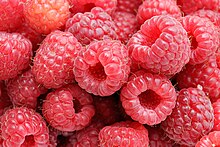
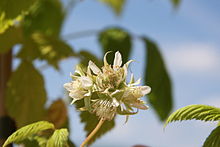 The Raspberry is the edible fruit of a multitude of plant species in the genus Rubus, most of which are in the subgenus Idaeobatus; the name also applies to these plants themselves. Raspberries are perennial. The name originally referred to the European species Rubus idaeus (with red fruit), and is still used as its standard English name.
 Raspberries are grown for the fresh fruit market and for commercial processing into individually quick frozen (IQF) fruit, puree, juice, or as dried fruit used in a variety of grocery products. Traditionally, raspberries were a mid-summer crop, but with new technology, cultivars, and transportation, they can now be obtained year-round. Raspberries need ample sun and water for optimal development. While moisture is essential, wet and heavy soils or excess irrigation can bring on Phytophthora root rot which is one of the most serious pest problems facing red raspberry. As a cultivated plant in moist temperate regions, it is easy to grow and has a tendency to spread unless pruned. Escaped raspberries frequently appear as garden weeds, spread by seeds found in bird droppings. The flowers can be a major nectar source for honeybees and other pollinators.
 Raspberries are very vigorous and can be locally invasive. They propagate using basal shoots (also known as suckers); extended underground shoots that develop roots and individual plants. They can sucker new canes some distance from the main plant. For this reason, raspberries spread well, and can take over gardens if left unchecked.
.jpg/220px-Raspberries_(Rubus_Idaeus).jpg)
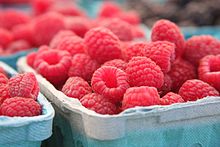 Raspberries contain significant amounts of polyphenol antioxidants such as anthocyanin pigments linked to potential health protection against several human diseases. The aggregate fruit structure contributes to its nutritional value, as it increases the proportion of dietary fiber, placing it among plant foods with the highest fiber contents known, up to 20% fiber per total weight. Raspberries are a rich source of vitamin C, with 30 mg per serving of 1 cup (about 50% daily value), manganese (about 60% daily value) and dietary fiber (30% daily value). Contents of B vitamins 1-3, folic acid, magnesium, copper and iron are considerable in raspberries.